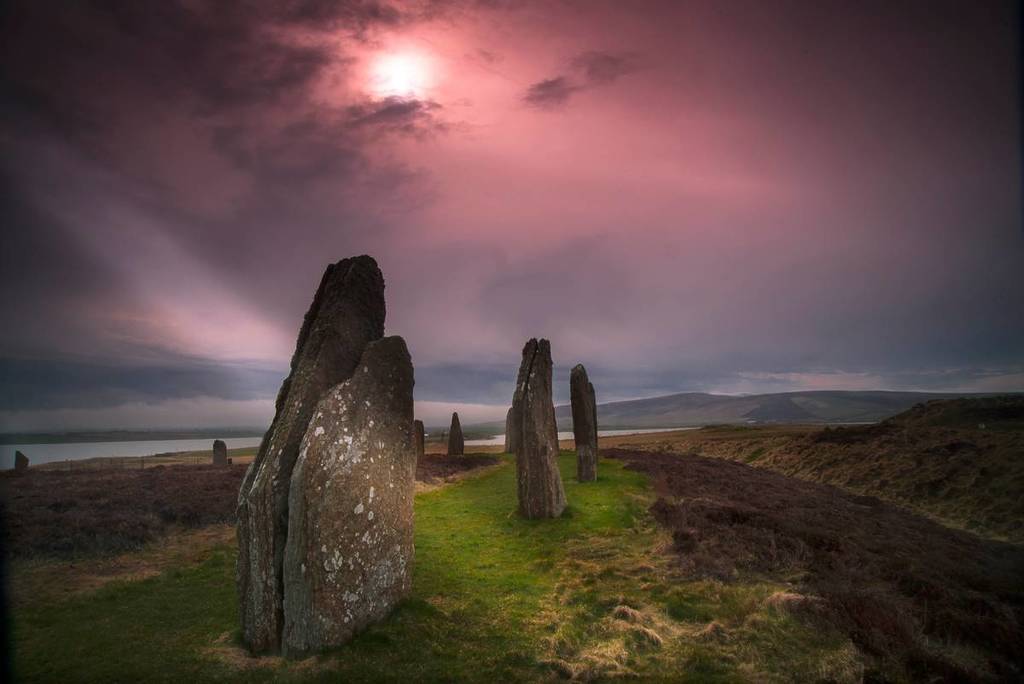

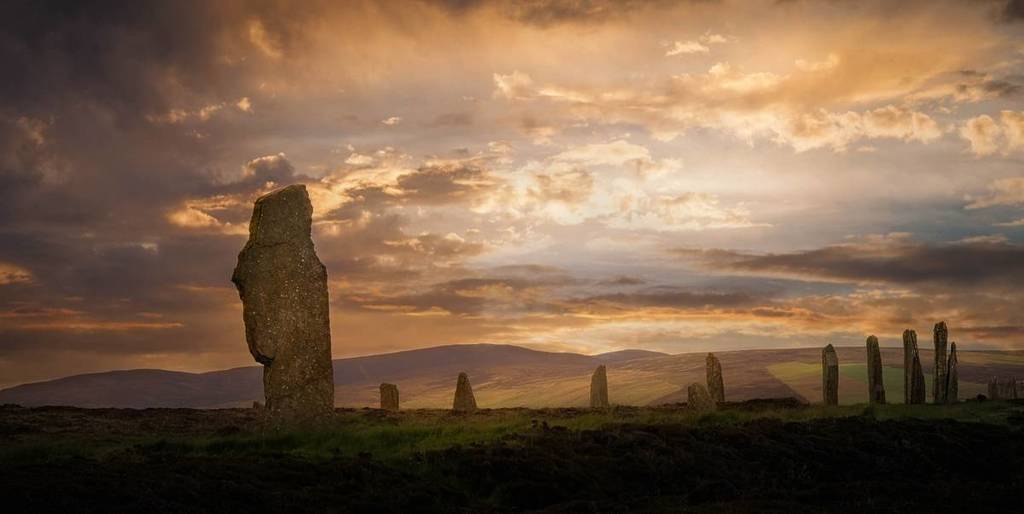
Nestled in the far north of the country, within the Orkney archipelago, lies Scotland’s most expansive stone circle: the Ring of Brodgar. This archaeological gem is a designated UNESCO World Heritage Site and ranks among the most photographed landmarks on the island, particularly for its breathtaking silhouettes at sunset.
At approximately 5,000 years old, this circle predates both Stonehenge and the Egyptian Pyramids, though it is actually younger than its nearby, smaller counterpart, the Stones of Stenness. To provide a sense of its massive scale, Stonehenge could actually fit entirely within the perimeter of the Ring of Brodgar.
Where did the stones come from, and how were they erected?
Naturally, many wonder about where these monoliths came from and how ancient civilisations managed to raise them. The explanation regarding their origin appears relatively simple: these massive slabs were sourced from all across Orkney. In fact, some stones can still be found today, resting on supports as if waiting to be transported. While the original builders aren’t coming back to finish the job, the sight of these “in-progress” stones is hauntingly beautiful.
The most plausible theory suggests that Neolithic locals manually hauled these giant stones to the sacred site on rolling supports, a feat of labour that likely took a massive physical toll. Experts also theorise that the builders either dragged the stones over the hilly terrain or utilised wooden rafts to transport the heavy segments by water.
However, the maritime transport theory is debated, as the Loch of Stenness was not connected to the sea during that era. Today, 21 stones remain standing, though 40 have been identified in total. Had the circle been completed with even spacing, it likely would have featured a whopping 60 stones.
What was the purpose of the Ring of Brodgar?
The Ring of Brodgar belongs to a massive network of ancient ceremonial landmarks throughout Orkney. The Stones of Stenness are located nearby, as are the Barnhouse Neolithic settlement and the Ness of Brodgar. The entire area is also peppered with Bronze Age tombs and burial mounds, reinforcing the idea that this landscape held deep sacred significance for millennia.
What is the mystery surrounding the Ring of Brodgar?
Those familiar with global ceremonial sites often expect them to be aligned with the stars or the sun. Surprisingly, the Ring of Brodgar displays no known astronomical alignment. If it doesn’t line up with the heavens, what was its focus? The truth behind its purpose remains a mystery.
It might have served as a venue for weddings, a marketplace, or a general community hub. Because there is no definitive way to uncover the internal spiritual world of Neolithic Scots, the answers will likely remain lost to time. For now, we can simply appreciate the stunning Orkney scenery and those iconic sunset photographs.