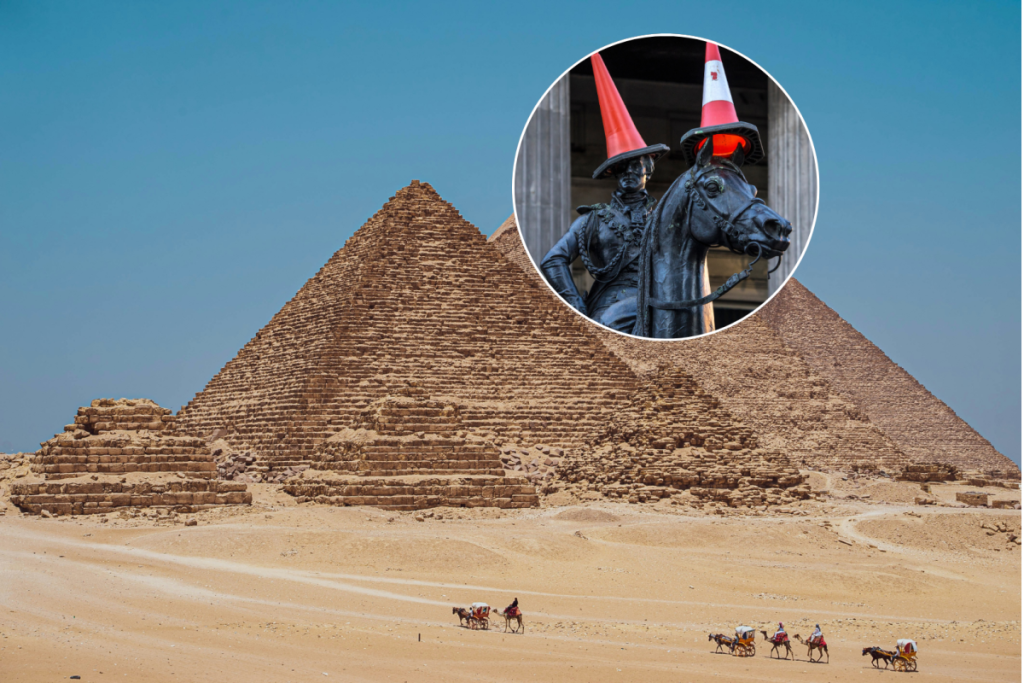

The early 1900s were no stranger to people making their mark on buildings, or even on one of the Seven Wonders of the World. And the oldest of the seven, the Pyramids of Giza, has been marked by “graffiti” from a Glaswegian, only to be discovered over a hundred years later.
Built around 4,500 years ago, the Pyramid of Khafre was created for the Pharaoh Khufu, and is the largest of the three tombs. However, the ancient structure officially has a nod to Glasgow from 1902, as new aerial shots discovered a Glaswegian “graffiti”.
The images clearly show the summit of the pyramid, with “J. Neilson Glasgow 1902.” carved into it. That’s right, from 1902!
It is believed that the Giza “graffiti” was done by a Glaswegian geologist James Nelson, who is believed to have visited Egypt around that time.
Ian Millar, secretary of the Geological Society of Glasgow, told The Herald: “The year carved looks to us as 1902.
“This tallies with his time in Egypt, his interest in the rock types used in the construction of the temples and monuments there, and his interest in archaeology as well as geology.
“It is, therefore, possible that he could be the author of the graffiti, though the J could be John, Jonathan, or Julian, for example, so in the absence of an admission verbally or in writing or other witness evidence, it could never be proven conclusively, an interesting mystery.
“Adding names or symbols to sites of historical or cultural importance appears to be as old as human history with Norse or Viking runes carved into palaeolithic sites and Byzantium buildings, Pictish eagles at Dunadd after the defeat of the Scots of Dalriada, for example though not to be encouraged.”
Currently, visitors are banned from climbing the pyramids, and have been since the 1950s. But in the early 1900s, climbing the Great Pyramid of Giza was a casual, widespread tourist activity aided by local guides.
If caught climbing the pyramids, tourists could face up to three years in jail, as well as face heavy fines.