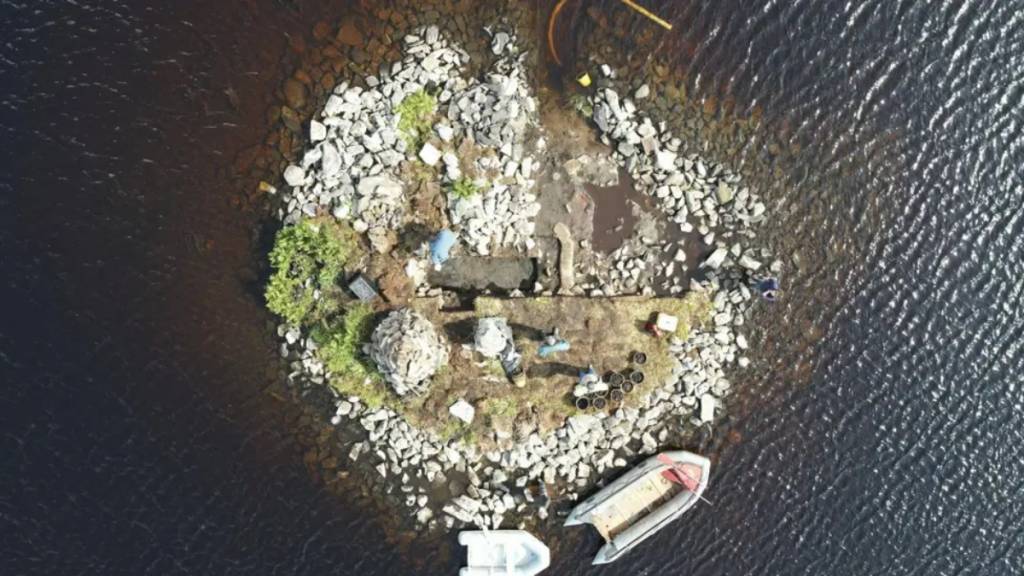

Did you know there are man-made islands, called crannogs, in Scotland? Well, now you do. And now, a hidden secret has been uncovered on a crannog in Loch Bhorgastail, unveiling what really lies underneath.
Crannogs are small artificial islands found in the lochs of Scotland, and there are still thousands of them across the country. Loch Bhorgastail in the Outer Hebrides is no exception, boasting a wee crannog that appears to be made of stone.
A hidden archaeological discovery
While there was initially knowledge that the island on Loch Bhorgastail contained some timber underneath, archaeologists from the University of Southampton discovered that wood was actually used to support the crannog. The findings were determined to date back to the Bronze Age, to around 3500 and 3300 BC.
What is more, hundreds of ancient pottery pieces were found during the excavation in the water, providing an abundant day for the team.
University of Southampton archaeologist, Dr Stephanie Blankshein, said: “When we actually started excavating, is when we realised that it was actually this coherent, quite large timber structure that was under what you would see as the stone island today.
“While we still don’t know exactly why these islands were built, the resources and labour required to construct them suggest not only complex communities capable of such feats, but also the great significance of these sites.”
The Loch Bhorgastail stone crannog
The wee stone island was discovered in 2009, no one knows its true purpose. First built 5,000 years ago, with more layers added as time went on. The most recent stone and birchwood layer is about 2,000 years old.