
You know Candlelight in Glasgow: the soft amber tide, the way a room seems to breathe just before the music begins. But have you ever wondered what makes that glow feel so natural?
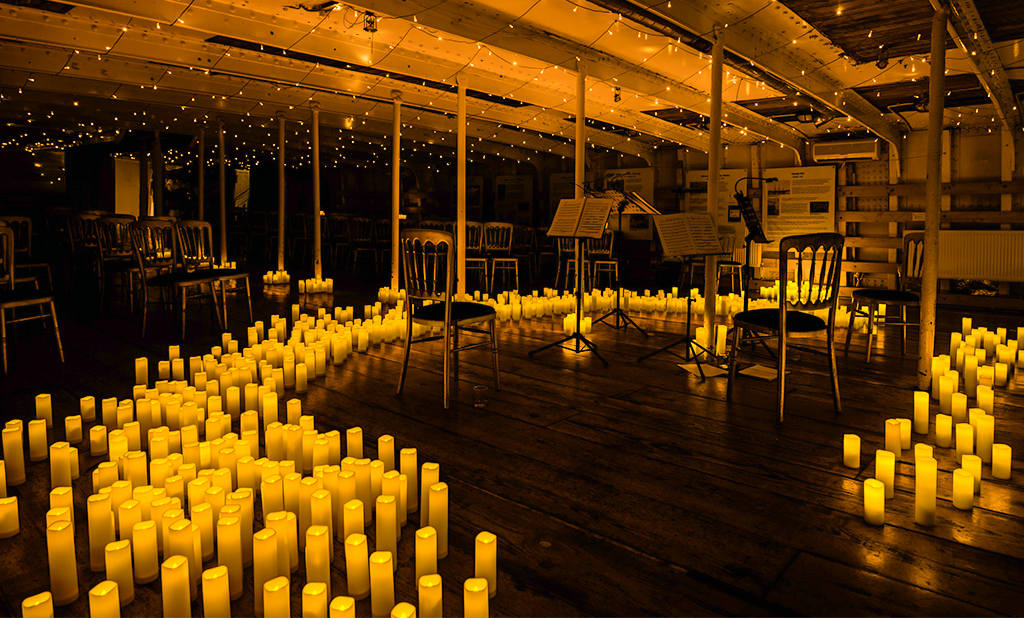
Think scale. 5,000 candles. 10,000 candles. Sometimes 15,000 candles. Always thousands of candles — rising and falling with the venue — arranged so the light feels seamless, not staged.
It looks effortless because the effort hides in plain sight. Before the first note, there’s a quiet choreography you rarely see, and it starts long before doors open.
And the magnitude? It isn’t a handful; it’s a landscape, which is why the set-up matters.
Table Of Contents
The moment before the music: how the set-up unfolds
First, unpacking: boxes open, trays appear, and rows of candles are lifted free. It’s measured, steady, almost metronomic.
Then, placement: clusters mark the edges, paths arc towards the stage, and lines echo the room’s geometry. You watch spaces become patterns — corners glow, aisles take shape.
Finally, lighting: one, then many, then a field of electric candles. The room warms by degrees as small points gather into a single atmosphere.
That’s when the transformation lands. At Merchants House of Glasgow, wooden panelling catches a mellow shimmer, portraits seem to lean closer, and the hall looks newly restored by light alone. The work recedes; the feeling remains.
You sense calm, but you’re sitting inside precise design. Candles frame sightlines, soften edges, and make the air look almost tangible. The sound feels nearer because the room feels nearer.
To put it in perspective: laid end to end, 30,000 candles would run from the Royal Concert Hall steps down Buchanan Street to George Square — and back again; stacked, those same candles would tower past the Finnieston Crane.

And after the applause, everything reverses. Each candle is dimmed, lifted, gathered, and returned to its case. Patterns disappear. Another venue waits. The cycle repeats — night after night, show after show — so that the next audience walks into light that feels inevitable.
Now, when you take your seat in Glasgow, you’ll know the glow didn’t simply arrive. It was built — patiently, piece by piece — so the music could feel as if it had always belonged there.
23 October 2026 18:15
Merchants House of Glasgow
6 November 2026 20:30 + more dates
Merchants House of Glasgow
31 October 2026 20:30 + more dates
Merchants House of Glasgow
6 November 2026 18:15 + more dates
Merchants House of Glasgow
31 October 2026 18:15 + more dates
Merchants House of Glasgow
14 November 2026 18:15 + more dates
Merchants House of Glasgow
13 November 2026 20:30 + more dates
Merchants House of Glasgow
14 November 2026 20:30 + more dates
Merchants House of Glasgow
8 November 2026 18:15 + more dates
Merchants House of Glasgow
13 November 2026 18:15
Merchants House of Glasgow
15 November 2026 20:30
Merchants House of Glasgow
15 November 2026 18:15
Merchants House of Glasgow
28 November 2026 20:30 + more dates
Merchants House of Glasgow
28 November 2026 18:15 + more dates
Merchants House of Glasgow
3 December 2026 18:15 + more dates
Merchants House of Glasgow
12 December 2026 18:15 + more dates
Merchants House of Glasgow
17 December 2026 18:15 + more dates
The Trades Hall
9 January 2027 18:15
Merchants House of Glasgow
23 January 2027 20:30
Glasgow Cathedral
23 January 2027 18:00 + more dates
Glasgow Cathedral
13 February 2027 18:15
Merchants House of Glasgow
20 February 2027 20:30
Glasgow Cathedral